

It’s been a minute since my last post (almost five months to be exact), so I thought I’d throw up a relatively low effort article on what a law enforcement officer’s or armed citizen’s everyday carry might look like. Equipment and what a Delta Green Agent might have on them at any given time comes up quite a bit, so hopefully this gives Agents and Handlers alike a good foundation to build on. The items below are just suggestions based on real-world training, experience, and applications, but they should provide a solid starting point.
REMINDER: FOUR RULES OF FIREARM SAFETY
- Always keep your firearm pointed in a safe direction.
- Treat all guns as if they are loaded.
- Keep your finger off the trigger until the sights are aligned and the decision to fire has been made.
- Know what’s in front of, behind, and to the sides of your target.
FIREARM & HOLSTER
When choosing a firearm to carry on a daily basis, some key factors to consider are your ability to shoot it accurately; how comfortable it is to carry; and how easy it is to conceal.
Obviously, if you can’t shoot your firearm accurately under stress, there’s really no point in carrying it. You’re just putting yourselves and others at risk.
If you’re armed with a large and bulky pistol that gets uncomfortable to wear after five minutes, the likelihood you’ll carry it every day decreases exponentially, because it just becomes a hassle.
A common concern with concealed carry is what’s referred to as “printing.” Simply put, printing is how much the outline of your firearm shows through your clothing when carrying concealed. The more you print, the more likely it is that someone will notice you’re carrying a weapon. Printing is not 100% avoidable, but you can mitigate it considerably based on the clothing you choose to wear. Tenicor, a holster manufacturing and firearm training company, has a phenomenal video (among others) that covers clothing considerations for concealed carry applications.
Holster choice comes down to personal preference, where you carry your firearm, and how well it helps you conceal your firearm. There are three primary carry positions: appendix, hip (or 3/9 o’clock depending on what your dominant hand is), or small-of-the-back (roughly 6 o’clock). Holsters also vary based on if you plan on carrying outside-the-waistband or inside-the-waistband.
I’m not a fan of what we call off body carry, or carrying a pistol in something like a backpack or waist bag/fanny pack, because it increases the amount of time it takes to get to your firearm and increases the possibility of leaving your weapon (and the bag it’s in) behind.
Some popular concealed carry firearms are the Glock 19, Glock 43X, Sig Sauer P365X, Smith & Wesson M&P Shield X, and the Springfield Armory Hellcat.
These days, I carry a Glock 47 MOS, which has the same dimensions as a Glock 19, but in a single stack (bullets in the magazine are held in a single column) vs. double stack configuration. This makes the grip slimmer and the pistol arguably more concealable. I carry it in an appendix inside-the-waistband (AIWB) Tenicor VELO5 holster.
Believe it or not, belt choice is also a critical consideration for concealed carry. You want to wear something that will keep your holster, and thus your firearm, secure against your body and is not flimsy enough to flex under the weight. I used a Blue Alpha Gear Low Profile EDC Belt for years, but recently switched to the Tenicor ZERO Belt.
I promise, this isn’t an ad for Tenicor. I just really like their stuff.
Disclaimer: If you make the decision to carry a firearm for defensive purposes, get training and take classes. This is not a decision to be made lightly, and you need to ensure you have the training necessary to actually use your firearm in a defensive situation.
AMMUNITION
How much ammunition should you carry on you? I’ve always lived by the rule that “two is one, one is none.” I carry a spare magazine on me at all times, to the left of my firearm and my centerline, in a Tenicor Abdo AIWB magazine pouch. This gives me access to 20 rounds of 9mm ammunition (one magazine in the pistol, one in reserve). When I end up switching my magazines to Shield Arms S15s, that amount will increase to 30. If I need any more than that, it’s gonna be a really bad day.
For the record, most law enforcement officers (including federal agents) have at least three magazines on them when on duty: one in the weapon, two in reserve. For example, the FBI now carries Glock 19s. This gives them 45 rounds of ammunition.
A lot of people like to pontificate on which caliber they think is the best. These days, many agree that improvements in ballistic technology and bullet manufacturing have made the 9mm the best “bang-for-your-buck” (pun intended) in most applications. Personal preference will of course dictate.
OPTICS & SIGHTS
You can’t shoot if you can’t aim (Firearm Safety Rule No. 4). Most firearms come with decent sights, the most egregious exception being Glocks. Stock Glock sights suck (try saying that three times fast). They’re cheap, plastic, and break easily.
If you’re going to swap out your factory sights, chose an alternative with a high contrast front sight that you can easily focus on when under stress. This is because you want to put all your focus on your front sight when employing your firearm in a gunfight. For example, I use the Ameriglo Protector line of sights, specifically the GL-436 set with a bright orange outline on the front sight and a black rear sight.
Optics, however, have justifiably increased in popularity. I personally love them. They allow for rapid target acquisition, increased accuracy, and faster follow-up shots. These days, I’ve been using the Vortex Defender-CCW micro red dot on my Glock 47.
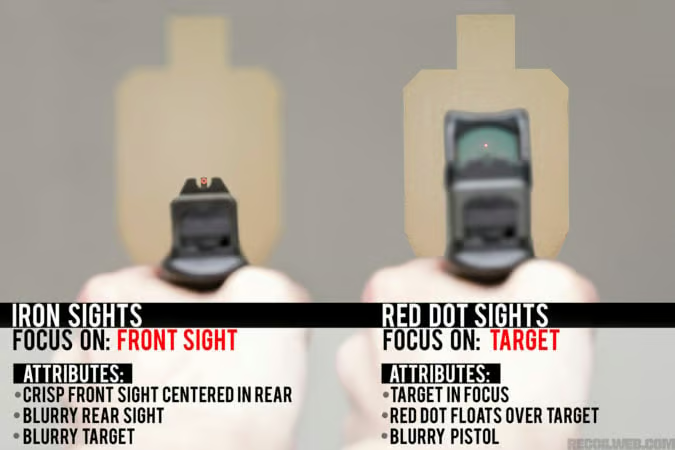
Image Source: Kimmell, Stephanie. (2019, August 15). Red Dot Sights – the Basics (and a little more). Gun Mag Warehouse. Retrieved November 2, 2025 from https://gunmagwarehouse.com/blog/red-dot-sights-the-basics-and-a-little-more/.
MEDICAL
If you have something to make holes, you also want something to plug holes. In today’s day and age, you’re far more likely to use any medical equipment you have on you than your firearm. At a minimum, for everyday concealed carry, you’ll want a tourniquet. These are applied to appendages, specifically the arms and legs, to quickly stop bleeding (an example being the femoral artery in the upper thigh). I personally carry a Combat Application Tourniquet (CAT) from North American Rescue. The Snake Staff Systems ETQ Gen 2 is making waves, but my personal opinion is it hasn’t been tested enough to show it’s a clear improvement over the CAT (but prospects are looking good).
I also carry an Apex Development MedMod at my lower back. With this, I can carry a tourniquet, a pair of chest seals (for sucking chest wounds), hemostatic gauze (for wound packing), and flat tape.
Disclaimer: if you’re going to carry medical equipment on you, make sure you know how to use it under stress. Stop the Bleed classes are a solid starting point.
KNIVES, TOOLS, & FLASHLIGHTS
I don’t usually carry a knife on me, apart from the one in my multitool, but if I do it’s the Benchmade Bugout.
I do carry a multitool, specifically the Leatherman Skeletool CX.
I also have a flashlight as opposed to a pistol-mounted light. If I need to illuminate an area, I don’t want to have to draw my firearm to do so (Firearm Safety Rule No. 1). I use a Streamlight Wedge XT specifically designed for EDC purposes.
TRAINING
Training is critical. Your Agent should know how to use anything they decide to carry. This means making liberal use of the “Improve Skills or Stats” personal pursuit during Home scenes. Training in Firearms and First Aid will improve both their own survivability and that of their fellow Agents should the proverbial feces hit the rotating oscillator.
WHAT ABOUT ARMOR?
Armor is not really a consideration for everyday carry, but some folks carry it in their vehicles and bug out bags. Armor is expensive, especially if you’re smart and stay away from the cheap steel stuff and opt for ceramic plates. As discussed in The Guns of Delta Green, Kevlar body armor is really only good for stopping pistol rounds. If you’re facing anything like a carbine or a hunting rifle, it (and you) will get shredded.
ANYTHING ELSE?
That should do it! If you have any questions you’d like addressed, or just need some more advice, feel free to leave a comment. I’ll either answer directly or use your inquiries for a future blog post. Thanks for reading, and I hope you find this useful!
Be seeing you,
Vince
JUST FOR LAUGHS
| Published by arrangement with the Delta Green Partnership. The intellectual property known as Delta Green is a trademark and copyright owned by the Delta Green Partnership, who has licensed its use here. The contents of this document are © 2025 by Vincent A. Kaufman, excepting those elements that are components of the Delta Green intellectual property. |
 Black Project Declassified
Leave a comment